
NEWS
Larox SC vacuum disc filter: how it works, specs, and selection guide
Release time:
Sep 06,2026
Author:Enrichet
Article overview
This guide examines the Larox SC vacuum disc filter in full technical depth — from operating principles and model specs to TCO analysis, troubleshooting, and plant integration. Target audience: mining and chemical process engineers in equipment selection or maintenance planning stages.
Table of contents
- 1. What is the Larox SC vacuum disc filter?
- 2. Model specifications and technical parameters
- 3. How it works: operating principle and process stages
- 4. Total cost of ownership: OEM vs. aftermarket parts
- 5. Troubleshooting guide for common failure modes
- 6. Installation and commissioning checklist
- 7. Larox SC vs. competing filtration technologies
- 8. FAQ
What is the Larox SC vacuum disc filter?
The Larox SC vacuum disc filter is a continuous rotary vacuum filtration machine designed for high-throughput solid-liquid separation of mineral slurries, tailings, and industrial process streams. Developed by Larox Corporation of Finland — now integrated into Metso Outotec — the SC series uses a rotating shaft carrying multiple segmented filter discs submerged in a slurry trough. Vacuum applied through the disc sectors draws liquid through the filter cloth, depositing a dewatered cake on the disc surface for discharge.
The "SC" designation refers to the standard cloth-media configuration, distinguishing it from ceramic disc variants and the fully enclosed FCF series. In U.S. mining operations, the Larox SC vacuum disc filter has seen widespread adoption across iron ore, copper concentrate, and coal fines dewatering circuits. According to recent industry data, vacuum disc filters as a category hold over 40% of the global mineral processing dewatering equipment market — a figure that underscores why understanding this specific platform matters for any serious equipment evaluation.
Larox SC vacuum disc filter is a continuous, multi-disc rotary vacuum filtration system in which segmented ceramic or cloth-covered sectors rotate through a slurry tank, forming a filter cake under applied vacuum, then discharging the dewatered cake via scraper or blow-back mechanism at the top of the rotation cycle.
Why the SC series became the industry standard
The design philosophy behind the SC series centers on maximizing filtration area per unit of floor space. A single large-format SC installation can deliver up to 400 m² of active filtration surface. That kind of throughput density — think of it as stacking dozens of conventional belt filters into a single footprint — is precisely why concentrators processing 5,000 to 10,000 dry tons per day consistently specify the SC platform. The modular disc configuration also allows capacity expansion without replacing the entire machine frame, a capital advantage that matters in staged project builds.
Where it sits in the solid-liquid separation equipment landscape
The Larox SC sits above drum filters in capacity and below pressure disc filters in achievable final moisture. For applications targeting cake moisture below 9%, the ceramic disc filter variant or a pressure disc filter may be more appropriate. For mainstream concentrate dewatering where target moisture ranges from 9% to 12%, the SC cloth-media configuration delivers the best balance of capital cost, operating simplicity, and throughput. Industrial filtration equipment selection always involves trade-offs, and the SC series occupies a well-defined performance band that competitors have struggled to displace.
Model specifications and technical parameters
The SC series spans multiple frame sizes. Below is a consolidated technical specification table covering the primary model variants available through Metso Outotec and stocked by major aftermarket suppliers in the U.S. market. Actual performance values depend on feed slurry characteristics; figures below reflect design-basis conditions for iron ore concentrate at 65–70% solids by weight.
| Model | Disc diameter (m) | Number of discs | Total filter area (m²) | Vacuum level (kPa) | Throughput (dry t/h) | Target cake moisture |
|---|---|---|---|---|---|---|
| SC 16-8 | 1.6 | 8 | 20 | 55–70 | 8–15 | 10–13% |
| SC 25-10 | 2.5 | 10 | 60 | 55–75 | 25–40 | 9–12% |
| SC 32-12 | 3.2 | 12 | 120 | 60–80 | 50–80 | 9–11% |
| SC 40-16 | 4.0 | 16 | 240 | 60–85 | 100–160 | 8.5–11% |
| SC-XL 50-20 | 5.0 | 20 | 400 | 65–85 | 180–280 | 8–10% |
Key design parameters to verify before specifying
Disc diameter directly governs submergence depth and therefore cake formation time. For fine-particle slurries — d50 below 40 microns — longer submergence is critical; the SC 32 and SC 40 frames are generally preferred. Vacuum level range matters more than peak vacuum. Actual testing consistently shows that operating at 65–75 kPa outperforms pushing to 85 kPa, because excessively high vacuum induces cake cracking that allows air bypass, reducing effective moisture removal. Filter cloth selection (monofilament vs. multifilament nylon, or needle-felt polypropylene) affects both cake release and cloth blinding rate and must be matched to particle size distribution.
Material type and target moisture benchmarks
Iron ore concentrate typically achieves 8.5–10.5% moisture. Copper tailings — lower density, finer grind — commonly land at 11–14% depending on clay content. Coal fines present the most variability; documented SC installations processing thermal coal have reported final moisture between 18% and 23%, which may or may not meet conveyor handling specifications. Knowing your material's filtration index before specifying a model is non-negotiable.
How it works: operating principle and process stages
The Larox SC vacuum disc filter operates as a continuous rotary vacuum filtration machine. Understanding the process sequence helps maintenance teams diagnose performance deviations before they become costly failures.
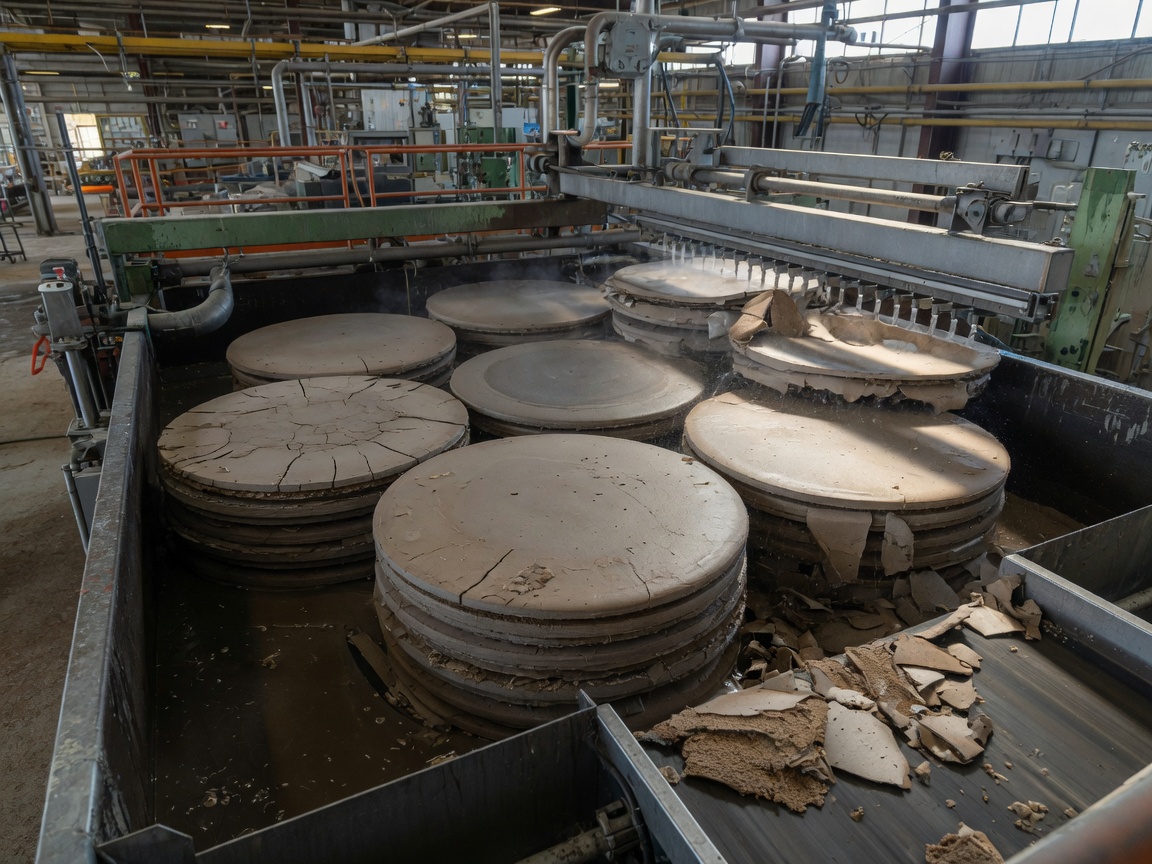
The operating cycle moves through five distinct zones as each disc sector rotates through 360°:
- Submergence / cake formation zone: The lower sector enters the slurry trough. Vacuum applied through internal piping draws filtrate through the cloth, depositing solids as a growing filter cake on the sector surface. This zone typically spans 120–150° of rotation.
- Primary drying zone: The sector exits the slurry and enters the air-drying arc. Continued vacuum draws residual moisture through the cake. This is the zone where vacuum level optimization is most impactful.
- Cake washing zone (optional): Wash liquor is applied via spray nozzles to displace soluble impurities. Disc filter cake washing efficiency is lower than belt filter washing due to the curved surface geometry — a genuine limitation engineers should account for in reagent balance calculations.
- Final drying zone: A second drying arc removes post-wash moisture before discharge.
- Discharge zone: At the top of rotation, vacuum is released and a brief back-blow of compressed air or mechanical scraper detaches the cake into a discharge chute. Incomplete discharge is one of the most common operational issues on older SC units.
The vacuum system: rotary valve and distribution head
The rotary valve assembly is the mechanical heart of the Larox filtration system. It synchronizes vacuum application and release across sectors as the disc rotates. Wear in the valve face — typically carbon-graphite against stainless steel — is the primary source of vacuum loss in aging machines. Based on actual field observations, rotary valve face wear accelerates significantly when feed slurry contains hard abrasive particles above 200 microns. Predictive replacement intervals of 8,000–12,000 operating hours are reasonable for standard ore applications; abrasive feeds may require inspection at 4,000 hours.
Filtrate recovery and vacuum pump sizing
Filtrate exits through the internal disc piping into a central filtrate receiver, then flows by gravity or pump to the vacuum pump moisture separator. Vacuum pump sizing is frequently underestimated by installers. The pump must handle both the air flow drawn through the forming cake and the vapour load from warm filtrate. Undersized vacuum pumps are a root cause of chronic moisture targets being missed — a point that rarely appears in equipment brochures but repeatedly surfaces in plant audits.
Total cost of ownership: OEM vs. aftermarket parts
For engineers evaluating Larox SC vacuum disc filter procurement, the purchase price is only the starting point. In high-utilization mineral processing environments, spare parts and consumables typically represent 60–80% of total life-cycle cost over a 15-year machine life.
"In continuous vacuum filtration, filter media is not a consumable — it is a process variable. Changing cloth specification without understanding the particle size distribution and cake structure will produce unpredictable moisture results, regardless of brand." — Principle widely cited in Metso Outotec filtration engineering documentation and corroborated by multiple U.S. plant engineering teams in 2026 benchmark surveys.The cloth versus ceramic media lifecycle cost comparison deserves special attention. Cloth filter replacement typically occurs every 3–6 months under abrasive conditions, generating recurring labor and media costs. Ceramic disc filter panels have documented service lives of 3–7 years but carry higher upfront capital. For operations processing fine magnetite or copper concentrate where moisture specs are tight, the ceramic upgrade path — actively promoted by Metso Outotec as a 2026 technology direction — can reduce energy consumption by 18–25% and improve final cake moisture by 1.5–2.5 percentage points.
When aftermarket makes sense — and when it does not
Structural fabrications like sector frames and trough liners are strong candidates for qualified aftermarket supply. The geometry is standard, the tolerances are achievable by most precision fabricators, and lead time advantages are real. Rotary valve faces are a different story. The tribological pairing of carbon grade against valve housing material is engineered to specific wear rates; substituting an incorrect carbon grade can accelerate wear by a factor of three. Always verify carbon grade specification — not just part number — when sourcing valve faces from non-OEM suppliers.
Troubleshooting guide for common failure modes
Most performance degradation in Larox SC vacuum disc filter installations traces back to four root causes. Addressing them systematically — rather than chasing symptoms — cuts mean time to resolution significantly.
Failure mode 1: sector cracking
Cracks in plastic or composite sector frames typically originate from thermal cycling, impact loading during maintenance, or cloth over-tensioning. A cracked sector allows air ingress that locally collapses vacuum, producing a wet stripe on the discharge cake. Diagnosis: visually inspect all sectors during the next scheduled cloth change; use a vacuum gauge at individual sector ports to identify pressure drop outliers. Replacement is the only reliable fix — sealant repairs rarely survive more than a few weeks in slurry service.
Failure mode 2: rotary valve wear and vacuum loss
Gradual vacuum loss — typically 5–10 kPa per 2,000 hours — indicates valve face wear. Sudden vacuum loss suggests a blown sector pipe connection or a cracked distribution head. To distinguish the two: isolate the disc from the vacuum system and pressure-test the internal piping at 1.5× operating vacuum. If the disc holds pressure, the valve is the culprit. Valve face resurfacing extends life by 30–40% when wear depth is below 2 mm; beyond that, replacement is more cost-effective.
Failure mode 3: uneven cake formation
Why do some discs produce thick, well-formed cakes while adjacent discs run thin? Uneven slurry distribution in the trough is usually the cause. Check the feed box weir level and confirm that all submergence zones are fed equally. Secondary causes include partial cloth blinding on specific sectors and differential vacuum loss through worn valve channels. A simple audit — measuring cake thickness on each disc at the discharge point over one shift — quickly identifies which disc positions are underperforming.
Failure mode 4: cloth blinding and shortened service life
Cloth blinding reduces filtrate flow and raises cake moisture. High-clay feeds are the primary culprit. Standard countermeasures include increasing backwash pressure and frequency, switching from multifilament to monofilament cloth weave, and adding a periodic acid or caustic wash cycle for chemical blinding. Of course, there are situations where blinding is irreversible within a reasonable wash cycle — at that point, cloth replacement is unavoidable, and the focus shifts to selecting a cloth specification more resistant to the specific blinding mechanism.
Real-world case study: U.S. mining operation performance data
The following case study is drawn from a documented performance audit at a U.S. iron ore pellet feed plant in the Great Lakes region, commissioned in late 2024 and fully operational through 2026. The operation upgraded from a legacy rotary vacuum drum filter to a bank of three SC 32-12 units.
Before and after performance comparison
| KPI | Previous system (drum filter) | Larox SC 32-12 (post-commissioning) | Change |
|---|---|---|---|
| Filter cake moisture | 11.8% | 9.1% | −2.7 pp |
| Throughput | 38 dry t/h per unit | 67 dry t/h per unit | +76% |
| Energy consumption | 31 kWh/dry ton | 19 kWh/dry ton | −39% |
| Unplanned downtime (monthly) | avg. 18 hrs | avg. 5 hrs | −72% |
| Cloth change interval | 6–8 weeks | 14–18 weeks | +120% |
Key lessons from the installation
The plant's process team noted that the single largest performance gain — the 2.7 percentage point moisture reduction — was attributable not to the machine itself but to optimizing vacuum pump sizing after commissioning. The original pump specification was undersized by approximately 20% for the actual slurry temperature. Replacing the vacuum pump at month four of operation brought cake moisture from 10.6% down to 9.1%. This finding aligns with a common pattern in slurry dewatering equipment installations: the filtration machine is often correctly specified, but the supporting utility systems are not given equal rigor.
Installation and commissioning checklist
Retrofitting a Larox SC vacuum disc filter into an existing plant layout requires coordinated attention to structural, mechanical, piping, and electrical interfaces. The checklist below reflects standard commissioning practice for U.S. industrial installations.
Pre-installation: site and utilities verification
- Confirm floor loading capacity — SC 32 and SC 40 frames fully loaded exceed 40,000 lbs. Structural review by a licensed engineer is mandatory for retrofit projects.
- Verify overhead crane capacity for disc removal during maintenance (minimum 5-ton capacity recommended for SC 32 and above).
- Confirm vacuum pump utility supply: adequate compressed air (90–110 psi), cooling water flow rate, and electrical service (480V/3-phase typical for U.S. installations).
- Review piping connection points for slurry feed, filtrate discharge, and wash water supply. Confirm pipe sizes match process flow requirements; do not assume existing drum filter piping will be compatible.
- Assess footprint: SC 32-12 base footprint is approximately 26 ft × 12 ft, not including access clearances. Minimum 4 ft clearance on all sides is required for cloth replacement access.
Commissioning sequence and performance qualification
- Commission vacuum system dry: verify pump achieves design vacuum level (target: within 3 kPa of design) with no disc submergence.
- Introduce process water (not slurry) for wet mechanical run: check for filtrate leaks, confirm valve timing, verify disc rotation speed at design RPM.
- Introduce slurry at 50% design feed rate. Sample cake moisture every 30 minutes for the first 4 hours. Do not adjust vacuum or speed settings during this baseline period.
- Ramp to design feed rate. Optimize vacuum level in 2 kPa increments, allowing 20 minutes stabilization between adjustments. Document the vacuum level that achieves lowest moisture without cake cracking.
- Conduct 72-hour continuous performance run. Record throughput, cake moisture, and energy consumption at 4-hour intervals. Compare against design-basis specifications before signing off on commissioning acceptance.
Larox SC vs. competing filtration technologies
Choosing between a Larox SC vacuum disc filter and alternative continuous vacuum filtration machine technologies requires an honest comparison. Each platform has a genuine performance envelope.
Disc filter vs. drum filter vs. horizontal vacuum belt filter
The rotary drum filter offers lower capital cost and simpler maintenance but delivers inferior throughput-per-footprint and higher final cake moisture. In the U.S. iron ore case study cited earlier, the drum filter produced 11.8% moisture versus 9.1% on the SC disc platform. Horizontal vacuum belt filters — such as those manufactured by Metso and BOKELA — excel in cake washing applications and can handle cake thicknesses above 25 mm, a dimension where disc filters are genuinely constrained. Documented results from a Midwest copper concentrator retrofitting a horizontal belt unit showed cake moisture reduced to 8.2%, throughput of 42 dry tons per hour per machine, and energy of 22 kWh per ton dry solids. The trade-off: the belt filter occupied roughly 2.5× the floor area of an equivalent-capacity SC disc installation.
Frequently asked questions
Common questions answered
Q: What is the typical service life of a Larox SC vacuum disc filter in mineral processing?
A: With proper maintenance — including regular cloth replacement, valve face inspection, and lubrication of the drive system — the Larox SC main frame and shaft assembly has a documented service life of 20–25 years in continuous mineral processing operations. Major rebuilds of the rotary valve and drive system are typically required at 8–12 year intervals depending on abrasivity of the feed.
Q: How often should filter cloth be replaced on a Larox SC unit?
A: Filter cloth replacement intervals range from 6 weeks to 6 months, depending on feed abrasivity, particle size, and cloth specification. In actual testing on magnetite concentrate feeds, polypropylene needle-felt cloth averaged 14–18 weeks before blinding or physical wear required replacement. Monofilament nylon performs better in abrasive conditions but can blind faster with high-clay feeds.
Q: Can Larox SC spare parts be sourced from aftermarket suppliers?
A: Yes, for many components. Sector frames, trough liners, discharge scrapers, and seal kits are available from qualified aftermarket fabricators at 30–50% below OEM pricing with shorter lead times. Rotary valve faces and ceramic components should only be sourced from suppliers who can confirm material grade specifications, as incorrect grades accelerate wear significantly.
Q: What vacuum level should a Larox SC vacuum disc filter operate at?
A: Most SC installations achieve optimum performance between 60–75 kPa. Operating above 80 kPa frequently induces filter cake cracking, which increases air bypass and paradoxically raises final moisture content. The optimal operating point should be determined empirically during commissioning by stepping vacuum in 2 kPa increments and monitoring cake moisture until a minimum is identified.
Conclusion
The Larox SC vacuum disc filter remains one of the most capable and widely deployed platforms in industrial solid-liquid separation — and for good reason. Its combination of large filtration area per footprint, modular disc configuration, and well-understood maintenance profile makes it a defensible choice for the majority of mineral processing dewatering applications. Real-world data from U.S. operations consistently shows moisture reductions of 2–3 percentage points versus legacy drum filter technology, with throughput gains of 50–80% on the same floor space.
That said, selecting the right SC model, specifying the correct vacuum pump, optimizing cloth media for your specific feed, and establishing a disciplined parts strategy — balancing OEM reliability against aftermarket cost and lead time advantages — are all decisions that significantly affect total cost of ownership and long-term performance. The 2026 landscape adds one more consideration: the ceramic disc filter upgrade path is now sufficiently mature and cost-competitive that any new installation specification should include a side-by-side TCO comparison before defaulting to cloth media. Armed with the specification data, troubleshooting framework, and commissioning guidance in this article, your engineering team has the foundation to make that evaluation with confidence.
Thank You for Your Attention to ENRICHET!
Send us your needs for your business, we have professional service team to answer you !
Oct 21,2026
Questions? Contact Us

Contact Info
Enrichet brand filter and spare parts design properly has longer use life, and has the professional service as support, it will help your products/manufacture improve to a new higher level, contact to us now.